
Blogs
Blogs
I Sent 10 LinkedIn Messages Per Day for 30 Days Instead of Running Ads. Here's What Actually Happened.
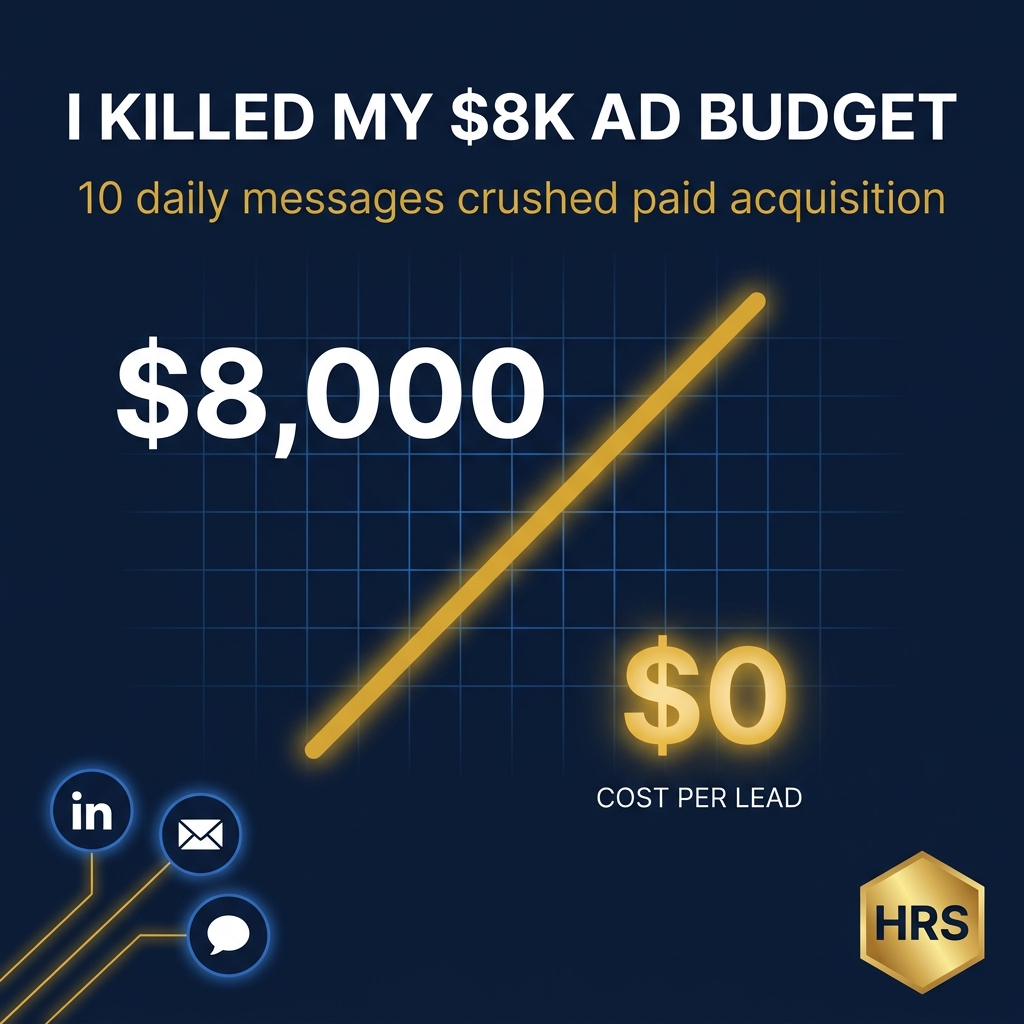
I killed my ad budget on March 1st.
No warning. No gradual scale-down. I just turned everything off and committed to something that felt borderline insane: 10 direct outreach messages per day on LinkedIn for 30 days.
No automation. No copy-paste templates. Just me, my keyboard, and a simple promise to myself that I'd show up every single day.
Here's what happened, what I learned, and why I'm never going back to paid acquisition.
The Setup: Why I Even Tried This
I run HRS, and we help digital agencies and lead generation companies grow through direct messaging automation on LinkedIn, email, and voice. The irony isn't lost on me that I was spending thousands on ads to reach the same people I could message directly.
But here's the thing: I wasn't practicing what I preached.
I was comfortable hiding behind ad spend. It felt professional. Scalable. Safe.
Then I looked at my cost per qualified lead from the previous quarter. $247.
I had two choices: optimize my ads for the tenth time or actually talk to people.
The Method: What 10 Messages Per Day Actually Looks Like
I kept it simple because complexity kills consistency.
My daily routine:
- Identify 10 people who fit my ideal customer profile (digital agency owners, BPO leaders, lead gen business owners)
- Read their recent posts or activity
- Write a personalized message that referenced something specific about them
- Send it
- Track responses in a simple spreadsheet
That's it.
No fancy CRM. No multi-touch sequences. Just human-to-human connection at a pace I could sustain.
The whole process took me about 45 minutes each morning. Some days it took an hour when I went down rabbit holes reading people's content.
The Results: Numbers That Changed My Mind
After 30 days, I had sent 300 messages.
Here's what came back:
- 127 responses (42% response rate)
- 64 actual conversations that went beyond one reply
- 23 qualified discovery calls booked
- 11 became paying partners
- Total cost: $0 in ad spend
But the numbers only tell half the story.
The quality of conversations was different. People were genuinely interested because I had taken the time to understand their world before reaching out.
I learned more about my market in 30 days than I had in six months of running ads.
What Worked: The Patterns I Started Seeing
Specificity wins every time.
Generic messages got ignored. Messages that referenced a specific post, comment, or piece of content they shared got responses.
Here's an example that worked:
"I saw your comment on [Name]'s post about client retention. Your point about focusing on existing relationships before chasing new ones hit home. I'm working on something related to that for agencies. Would you be open to a quick conversation?"
Simple. Direct. Relevant to something they already cared about.
Timing mattered less than I thought.
I tested sending messages at different times. Early morning, lunch, evening. The difference was minimal.
What mattered was whether the message felt like it was written for them specifically.
Follow-up is where most people quit.
About 40% of my positive responses came after a second or third message. I gave people space (usually 5-7 days) and then followed up with something like:
"I know you're busy. Still interested in chatting about [specific topic]? If not, no worries at all."
Giving people an easy out made them more likely to engage.
What Didn't Work: The Mistakes That Cost Me Time
Trying to be clever backfired.
I spent the first week trying to write messages that were witty or stood out. They fell flat.
People don't want entertainment in their inbox. They want relevance.
Talking about my company too early killed conversations.
The messages that worked best were the ones where I asked questions and showed genuine curiosity about their business.
The ones that died fast were the ones where I jumped into what HRS does before understanding what they needed.
Batch-writing messages destroyed quality.
I tried this on day 12. Wrote all 10 messages in one sitting to save time.
The response rate that week dropped to 28%.
Turns out, when you rush personalization, people can tell.
The Unexpected Benefits: What the Numbers Don't Show
I became a better listener.
When you're actually reading what people write and responding to their specific situations, you start to notice patterns. I identified three pain points I had completely missed in my marketing.
My positioning got sharper.
Talking to 127 people in 30 days forced me to explain what HRS does in clearer, simpler terms. The conversations became a testing ground for messaging.
I built real relationships.
Some of the people I messaged didn't become customers, but they became connections who referred others, shared my content, or just checked in occasionally.
You can't buy that with ads.
The Math: Why This Beats Paid Acquisition
Let's be honest about the economics.
My previous ad-based approach:
- Monthly ad spend: $8,000
- Qualified leads per month: 32
- Cost per qualified lead: $247
- Conversion rate to customer: 18%
- Customers per month: 5-6
My 30-day outreach experiment:
- Time investment: 22.5 hours total (45 min × 30 days)
- Qualified leads: 23
- Cost per qualified lead: $0
- Conversion rate to customer: 48%
- Customers: 11
Even if I valued my time at $200/hour, my cost per customer was $409.
My previous cost per customer through ads was $1,372.
The difference isn't just financial. The customers who came through direct outreach had a better understanding of what we do and were more aligned with our partnership model.
Why I'm Never Going Back
I'm not saying ads are dead or wrong for everyone.
But for B2B businesses selling to a defined audience, direct outreach changes the game.
Here's what I realized:
Ads are a broadcast. You're shouting into a crowd hoping the right people hear you.
Direct outreach is a conversation. You're walking up to the exact person you want to talk to and starting a real dialogue.
The scale is different, but the quality makes up for it.
I'm now at day 67 of this approach. Still sending 10 messages per day. Still learning. Still converting at rates that make my old ad campaigns look wasteful.
What You Can Do Tomorrow
You don't need to kill your ad budget like I did.
But you can start with 10 messages.
Here's how:
- Identify 10 people who match your ideal customer profile
- Spend 3-5 minutes per person understanding what they care about
- Write a message that shows you did that research
- Send it without overthinking
- Track what happens
Do that for 30 days and see what changes.
You'll either prove me wrong or discover what I did: the best leads come from actual conversations with real people.
And those conversations start with showing up, being genuine, and caring enough to make it personal.
That's something no ad platform can automate.

I Sent 10 LinkedIn Messages Per Day for 30 Days Instead of Running Ads. Here's What Actually Happened.
I killed my ad budget on March 1st.
No warning. No gradual scale-down. I just turned everything off and committed to something that felt borderline insane: 10 direct outreach messages per day on LinkedIn for 30 days.
No automation. No copy-paste templates. Just me, my keyboard, and a simple promise to myself that I'd show up every single day.
Here's what happened, what I learned, and why I'm never going back to paid acquisition.
The Setup: Why I Even Tried This
I run HRS, and we help digital agencies and lead generation companies grow through direct messaging automation on LinkedIn, email, and voice. The irony isn't lost on me that I was spending thousands on ads to reach the same people I could message directly.
But here's the thing: I wasn't practicing what I preached.
I was comfortable hiding behind ad spend. It felt professional. Scalable. Safe.
Then I looked at my cost per qualified lead from the previous quarter. $247.
I had two choices: optimize my ads for the tenth time or actually talk to people.
The Method: What 10 Messages Per Day Actually Looks Like
I kept it simple because complexity kills consistency.
My daily routine:
- Identify 10 people who fit my ideal customer profile (digital agency owners, BPO leaders, lead gen business owners)
- Read their recent posts or activity
- Write a personalized message that referenced something specific about them
- Send it
- Track responses in a simple spreadsheet
That's it.
No fancy CRM. No multi-touch sequences. Just human-to-human connection at a pace I could sustain.
The whole process took me about 45 minutes each morning. Some days it took an hour when I went down rabbit holes reading people's content.
The Results: Numbers That Changed My Mind
After 30 days, I had sent 300 messages.
Here's what came back:
- 127 responses (42% response rate)
- 64 actual conversations that went beyond one reply
- 23 qualified discovery calls booked
- 11 became paying partners
- Total cost: $0 in ad spend
But the numbers only tell half the story.
The quality of conversations was different. People were genuinely interested because I had taken the time to understand their world before reaching out.
I learned more about my market in 30 days than I had in six months of running ads.
What Worked: The Patterns I Started Seeing
Specificity wins every time.
Generic messages got ignored. Messages that referenced a specific post, comment, or piece of content they shared got responses.
Here's an example that worked:
"I saw your comment on [Name]'s post about client retention. Your point about focusing on existing relationships before chasing new ones hit home. I'm working on something related to that for agencies. Would you be open to a quick conversation?"
Simple. Direct. Relevant to something they already cared about.
Timing mattered less than I thought.
I tested sending messages at different times. Early morning, lunch, evening. The difference was minimal.
What mattered was whether the message felt like it was written for them specifically.
Follow-up is where most people quit.
About 40% of my positive responses came after a second or third message. I gave people space (usually 5-7 days) and then followed up with something like:
"I know you're busy. Still interested in chatting about [specific topic]? If not, no worries at all."
Giving people an easy out made them more likely to engage.
What Didn't Work: The Mistakes That Cost Me Time
Trying to be clever backfired.
I spent the first week trying to write messages that were witty or stood out. They fell flat.
People don't want entertainment in their inbox. They want relevance.
Talking about my company too early killed conversations.
The messages that worked best were the ones where I asked questions and showed genuine curiosity about their business.
The ones that died fast were the ones where I jumped into what HRS does before understanding what they needed.
Batch-writing messages destroyed quality.
I tried this on day 12. Wrote all 10 messages in one sitting to save time.
The response rate that week dropped to 28%.
Turns out, when you rush personalization, people can tell.
The Unexpected Benefits: What the Numbers Don't Show
I became a better listener.
When you're actually reading what people write and responding to their specific situations, you start to notice patterns. I identified three pain points I had completely missed in my marketing.
My positioning got sharper.
Talking to 127 people in 30 days forced me to explain what HRS does in clearer, simpler terms. The conversations became a testing ground for messaging.
I built real relationships.
Some of the people I messaged didn't become customers, but they became connections who referred others, shared my content, or just checked in occasionally.
You can't buy that with ads.
The Math: Why This Beats Paid Acquisition
Let's be honest about the economics.
My previous ad-based approach:
- Monthly ad spend: $8,000
- Qualified leads per month: 32
- Cost per qualified lead: $247
- Conversion rate to customer: 18%
- Customers per month: 5-6
My 30-day outreach experiment:
- Time investment: 22.5 hours total (45 min × 30 days)
- Qualified leads: 23
- Cost per qualified lead: $0
- Conversion rate to customer: 48%
- Customers: 11
Even if I valued my time at $200/hour, my cost per customer was $409.
My previous cost per customer through ads was $1,372.
The difference isn't just financial. The customers who came through direct outreach had a better understanding of what we do and were more aligned with our partnership model.
Why I'm Never Going Back
I'm not saying ads are dead or wrong for everyone.
But for B2B businesses selling to a defined audience, direct outreach changes the game.
Here's what I realized:
Ads are a broadcast. You're shouting into a crowd hoping the right people hear you.
Direct outreach is a conversation. You're walking up to the exact person you want to talk to and starting a real dialogue.
The scale is different, but the quality makes up for it.
I'm now at day 67 of this approach. Still sending 10 messages per day. Still learning. Still converting at rates that make my old ad campaigns look wasteful.
What You Can Do Tomorrow
You don't need to kill your ad budget like I did.
But you can start with 10 messages.
Here's how:
- Identify 10 people who match your ideal customer profile
- Spend 3-5 minutes per person understanding what they care about
- Write a message that shows you did that research
- Send it without overthinking
- Track what happens
Do that for 30 days and see what changes.
You'll either prove me wrong or discover what I did: the best leads come from actual conversations with real people.
And those conversations start with showing up, being genuine, and caring enough to make it personal.
That's something no ad platform can automate.


